

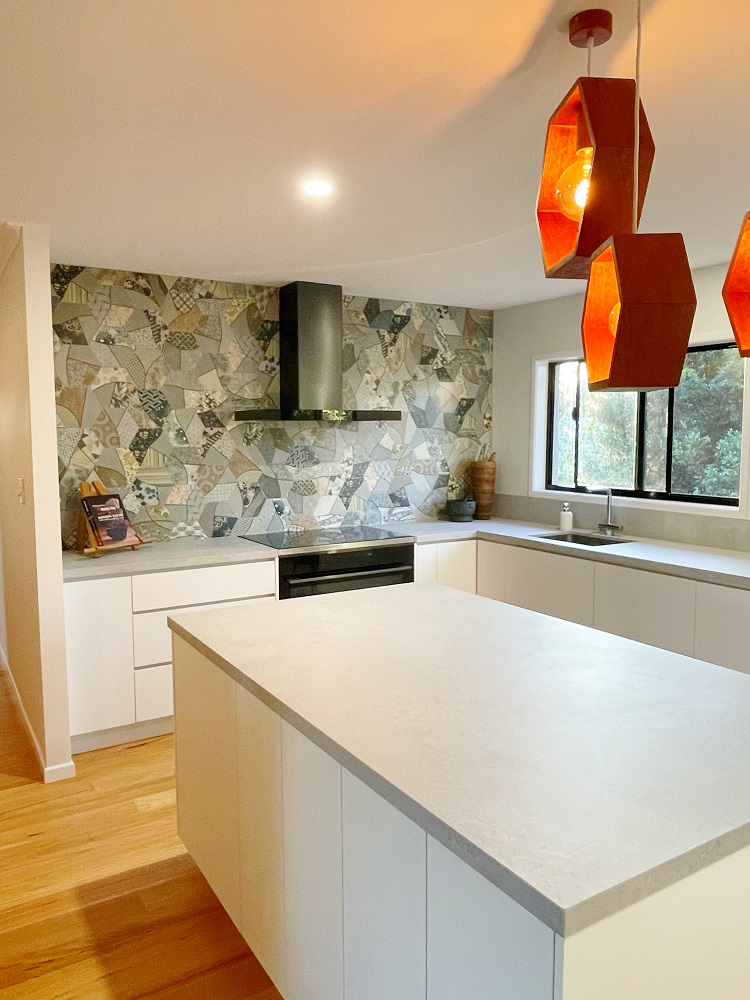
When planning a kitchen renovation, one of the first questions homeowners usually face is what the cabinetry should be made from.
That sounds simple until terms like Laminex, MDF, melamine, Shaker, 2-pack, timber veneer and plywood start getting thrown around.
The confusing part is that these aren’t actually all competing products.
- A Shaker door is a style.
- MDF and particleboard are materials.
- 2-pack polyurethane is a painted finish.
- Laminex is a brand that manufactures a range of decorative surfaces and board products.
That means a kitchen could quite reasonably have melamine cabinet carcasses, MDF Shaker doors finished in 2-pack polyurethane and Laminex timber-look cabinetry around the island.
Understanding the difference makes it much easier to compare kitchen quotes and decide where your renovation budget is actually going.
First, Understand How Kitchen Cabinetry Is Built
Most modern kitchens are made up of several different components rather than one single material.
The internal cabinet boxes, usually called the carcasses, may be made from melamine-faced particleboard.
The visible cabinet doors might be made from MDF.
Those doors could then be painted with a 2-pack polyurethane coating.
A feature panel might use timber veneer.
The benchtop is another material again.
So when somebody asks, “What are your kitchen cabinets made from?”, the answer may actually involve several different materials. That is completely normal. The important question is whether each material is appropriate for where it is being used.
Particleboard and Melamine Cabinetry
Particleboard is one of the most widely used materials in modern kitchen cabinetry.
It is manufactured by combining wood particles with resin and pressing them into sheets. A decorative melamine surface is then commonly applied to the board.
This type of board is regularly used for cabinet carcasses, shelving and flat cabinet doors.
It sometimes gets dismissed because it is less expensive than some alternatives, but good-quality melamine board can perform extremely well in a kitchen when it is manufactured and installed correctly.
| Advantages | Considerations |
|---|---|
| Relatively affordable | Water can cause swelling if it reaches the internal board |
| Large range of colours and finishes | Damaged surfaces are difficult to repair invisibly |
| Easy to clean | Edges need to be properly sealed |
| Consistent appearance | Doesn’t provide the same detailed profiles as routed MDF |
| Excellent for cabinet interiors | Quality can vary between products |
The real enemy of particleboard is not everyday kitchen use. It is prolonged moisture entering an exposed or damaged edge. This is why workmanship around sinks, dishwashers and plumbing penetrations matters.
What Is Laminex?
Laminex is one of the best-known cabinetry brands in Australia, which has led to the name sometimes being used as if it describes a type of cabinet.
It is more accurate to think of Laminex as a manufacturer of decorative surfaces and board products.
When someone says they want “Laminex cabinets”, they may be referring to decorative melamine board from the Laminex range.
These products are available in a huge variety of colours, textures and patterns.
You can create cabinetry that looks like:
- Timber
- Stone
- Concrete
- Solid painted colours
- Matte finishes
- Textured surfaces
This makes decorative board particularly useful for modern kitchens where homeowners want a clean finish without moving into the price range of custom-painted joinery.
Why Homeowners Choose Laminex-Style Decorative Cabinetry
The biggest advantage is versatility.
A relatively simple flat cabinet door can look completely different depending on the finish selected.
Timber-look finishes can add warmth. Matte neutrals can create a minimalist kitchen. Darker finishes can provide contrast around an island or bar area.
They are also generally easy to maintain because the surface does not require the same ongoing treatment as genuine timber.
The limitation is that the edges of the board normally require separate edge banding. Good manufacturing can make this extreme